
Roof Heat Cable and Heat Tape in Bozeman: Ice Dams, Frozen Pipes and Safe Circuits
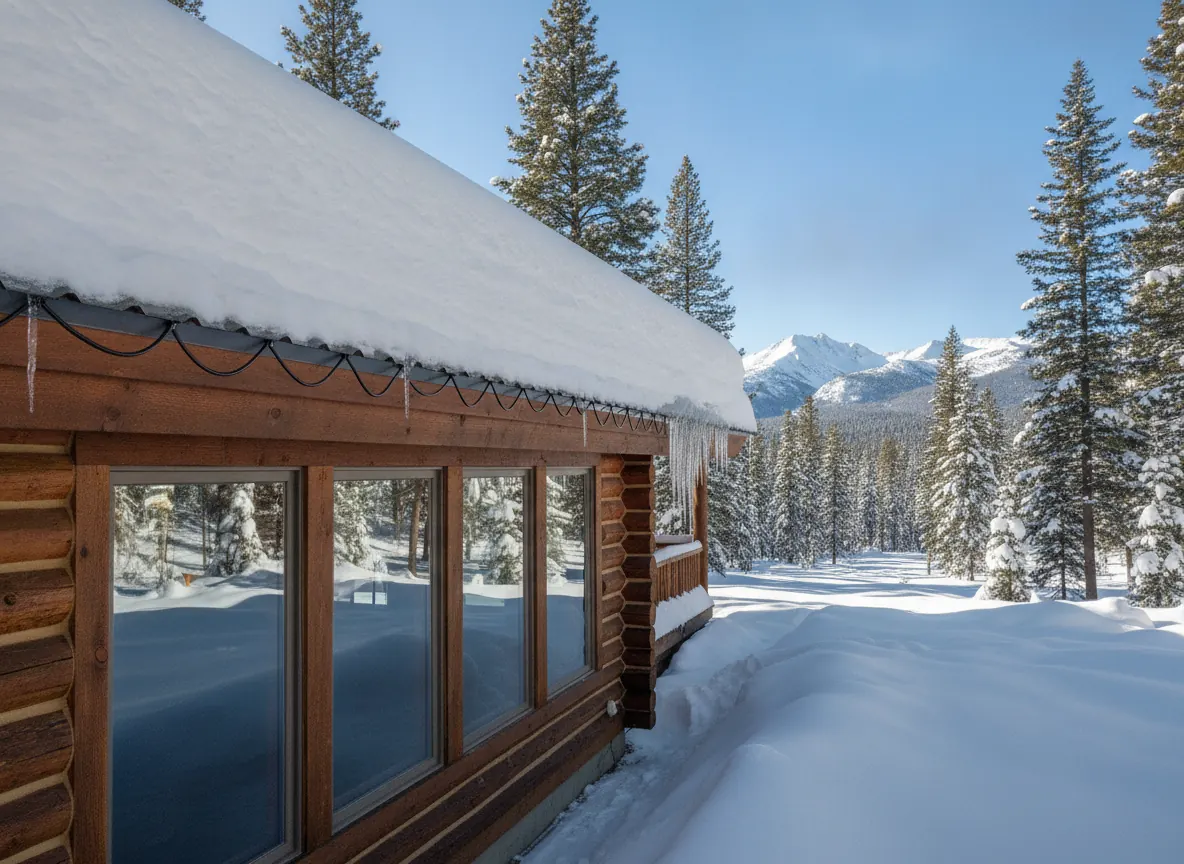
Bozeman, MT averages 91.3 inches of snow a year at the Montana State University weather station (NOAA 1991–2020 normals), and about 178 nights a year at or below freezing. Snow that melts on a warm roof and refreezes at the cold eaves builds ice dams, and pipes in crawlspaces and exterior walls freeze when a cold snap settles in. Roof heat cable and pipe heat tape are the usual answers. Both are electrical equipment that sits outdoors or in damp spaces for months, so how they are wired and protected matters as much as where they are clipped.
This guide covers the electrical side: circuits, ground-fault protection, plug-in versus hardwired systems, controls, old tape, cost and permits around Bozeman and the Gallatin Valley.
General guidance, not a repair guide. Do not climb an icy roof to work on cable, and do not splice or extend heat cable yourself. If a heat cable or its outlet is scorched, melted, smells hot or keeps tripping the GFCI, unplug it or switch off its breaker and leave it off. If there is smoke or fire, call 911.
Heat cable vs. heat tape: what is the difference?
People use the names loosely. In practice there are two jobs:
- Roof and gutter de-icing cable runs in a zigzag along the eaves and down through gutters and downspouts. Its job is to keep a melt channel open so water can drain instead of backing up under shingles.
- Pipe heat tape or heat cable is fastened along a water line, often under insulation, to keep it above freezing. It is common on well lines, crawlspace plumbing, manufactured-home supply lines and pipes in unheated garages.
Both come in two main styles. Constant-wattage cable puts out the same heat along its length whenever it is on. Self-regulating cable adjusts its output to the temperature around it, so it runs cooler where it is warm. Self-regulating products are generally the safer choice where cable might touch itself or sit under insulation, but follow the manufacturer's instructions for the exact product.
Does roof heat cable stop ice dams?
It manages them; it does not cure them. Ice dams form because heat escaping through the attic melts snow higher on the roof. Air sealing, insulation and ventilation address that cause. Heat cable keeps a path open at the eaves and in the gutters so meltwater can drain. On older Bozeman homes with low-slope additions, shaded north eaves or valleys that collect drift, cable is often the practical fix while longer-term attic work waits. Ask a roofer or energy auditor about the cause; ask an electrician about the circuit.
Why the circuit matters
A long run of heat cable is a continuous load for weeks at a time. That is different from a toaster or a vacuum. The questions an electrician will look at:
- Load. Each product lists watts per foot. Total length times watts per foot gives the load, and continuous loads are sized with extra margin. A few hundred feet of roof cable can need its own circuit or several.
- Ground-fault protection. The National Electrical Code generally requires ground-fault protection for fixed outdoor de-icing equipment, and outdoor receptacles generally need GFCI protection. The protection is often built into a GFCI or GFPE breaker or a listed controller. A heat cable that trips its ground-fault device is usually telling you something is wrong with the cable or a connection.
- A shared circuit. Plugging roof cable into an exterior outlet that also feeds holiday lights, a block heater or a garage freezer is a common reason for nuisance trips in January.
- Weatherproof connections. Outdoor outlets need in-use covers that stay closed with a cord plugged in. Junction boxes for hardwired cable need to be rated for the location.
If an outdoor GFCI keeps tripping every time the snow melts, see our guide to why breakers trip in winter and the outlets and GFCI page.
Plug-in or hardwired?
| Setup | Good fit | Watch for |
|---|---|---|
| Plug-in kit on an existing GFCI outlet | Short runs, one gutter or one downspout, a single pipe | Shared circuits, extension cords, covers that do not close, no thermostat |
| Plug-in kit on a new dedicated outdoor GFCI outlet | Several short runs on one side of the house | Total load still has to fit the circuit |
| Hardwired system with ground-fault breaker | Long eaves, valleys, multiple zones | Needs a permit, panel space and a planned cable layout |
| Hardwired with a controller and snow or moisture sensor | Large roofs, second homes, anyone who forgets to switch it on and off | Higher upfront cost; sensor placement matters |
Extension cords are a poor permanent setup. They are not meant to sit in snow all winter, and they hide overloaded outlets. If a kit needs a cord to reach, that is a sign it needs an outlet where the cable starts.
Controls save energy and wear
A cable left on from November to April uses a lot of electricity. Options include a simple switch, a timer, an outdoor thermostat that turns the cable on only in a temperature band, and a snow or moisture sensor that runs it only when there is something to melt. On a second home in Big Sky or a rental near MSU, an automatic controller means nobody has to remember. Some systems add an indicator light so you can see from the ground that the circuit is live.
Old heat tape: when to replace it
Heat tape that has been on a pipe for many winters can crack, fray or overheat where it is wrapped over itself or buried in the wrong kind of insulation. Signs it is time to replace it:
- cracked, brittle or discolored jacket, or exposed wire
- tape wrapped over itself when the instructions say not to
- a plug or outlet that is warm, melted or scorched
- no listing label, or no instructions you can find for the product
- a GFCI that trips as soon as it is plugged in
Unplug a damaged tape and leave the pipe protected some other way until it is replaced. In a crawlspace or a manufactured home, an electrician can also check that the outlet feeding it is ground-fault protected and in good shape.
What does roof heat cable cost in Bozeman?
Published national cost guides put roof heat cable at about $5–$15 per linear foot installed (HomeGuide). A 100-foot run works out to roughly $500–$1,500. Those are national estimates, not quotes. Quotes come from independent contractors, not this site. A new dedicated circuit, a ground-fault breaker, a controller, or panel work if the panel is full all add to the price. See the Bozeman electrician cost guide for the full table and a calculator.
Ask for a written, itemized quote that separates the cable, the circuit work, the controls and any permit. Ask whether the contractor also installs the cable on the roof or only wires it, since some jobs involve a roofer too.
Do you need a permit for heat cable?
Plugging a listed kit into an existing outlet usually is not permit work. Adding a circuit, a hardwired system or a new outdoor outlet is. Bozeman, Belgrade and Manhattan issue electrical permits inside city limits; everywhere else in the valley, including Livingston, Three Forks, Big Sky and Four Corners, permits come from the Montana Department of Labor & Industry. The state residential permit form lists $45 for one added circuit or piece of equipment. City fees are set by each city; ask the contractor or the city building division. Ask who pulls the permit and books the inspection.
Planning a heated driveway or walk instead of just the eaves? That is a bigger load and a different job; see snow-melt and heated driveways.
Bozeman Electricians is a free quote-referral service, not an electrician. If you want quotes, describe the job once and independent electricians licensed by the Montana State Electrical Board can reply on their own schedules.
Frequently asked questions
Does roof heat cable need a GFCI?
Generally yes. The National Electrical Code generally requires ground-fault protection for fixed outdoor de-icing equipment, and outdoor outlets generally need GFCI protection. Hardwired systems often use a ground-fault breaker or a listed controller. An electrician will match the protection to the product and the code that applies.
Why does my heat tape keep tripping the GFCI?
Common causes are water in an outlet or connection, a damaged cable jacket, too much cable on one circuit, or other loads sharing the outlet. Do not bypass the GFCI. Unplug the cable and have it and the outlet checked.
Can heat tape be left plugged in all winter?
Many products are designed to stay connected through the season, especially self-regulating cable with a thermostat. Follow the manufacturer's instructions, check the cable each fall, and replace tape that is cracked, discolored or wrapped over itself.
How much does roof heat cable cost to install?
Published national cost guides put it at about $5 to $15 per linear foot installed, so roughly $500 to $1,500 for 100 feet. A new circuit, controls or panel work add to that. These are estimates, not quotes.